Analemmatic dials

Besançon (Doubs, France) - not the forgotten dial anymore
A committee, consisting of:
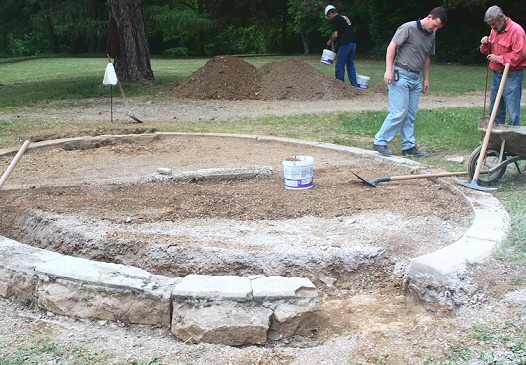
Restoration is well under way right now. The committee has raised most of the necessary money, some 10,000 Euro. Would you like to contribute?
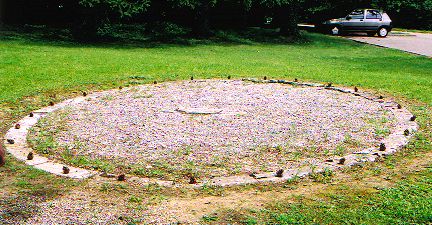
No, the sundial did not exist anymore, according to the friendly lady at the Observatory of Besançon who answered my query. As I insisted, she added that it once lay near the parking lot across the street. Were there no remains? No, really, she assured us, nothing was left.
When we left, we kind of sneaked into the parking lot, just to find these remains. Apparently the lady was embarrassed by the miserable state of this object. Nevertheless, it's still there, and it clearly was a very pretty sundial - once.
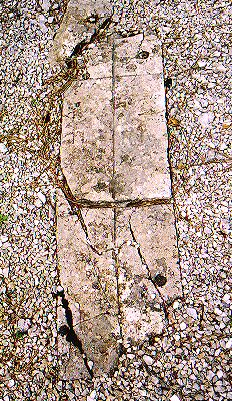 The size of the dial is just right: the major axis is 6 m (20 ft). The date line was eroded so heavily that no inscriptions could be identified.
Using the abundant pine-cones around, Manon highlighted the hour points, which we retraced with some difficulty. All 24 of them, as they formed a complete ring. Additional marks had been engraved per quarter of an hour.
The hour points number from 0 to 23. That is remarkable: in the other dials with a complete hour ring (Brou, Dijon, Gray) the hours run twice from I to XII. Even more noteworthy: 0 is at the north side, where your shadow would fall at noon. A posting on the Sundial Mailing List revealed that prior to 1925 astronomers used the Julian hour numbering system, in which the day started at noon. In that way the date would not change during working hours, which was practical when recording observations!
This implied that the dial was constructed prior to 1925.
Dr. Denis Savoie, president of the Commission des Cadrans Solaires of the Société Astronomique de France, informed me that the dial was constructed in 1902, under supervision of the director of the Observatory at that time, L.-J. Gruey. That makes it the third-oldest analemmatic dial in the world, after those in Brou (16th/17th century) and Dijon (1827), and preceding those in Montpellier (1927), Avignon (1931) en Vienne (1937), which one sees listed all the time. Why has this special dial fallen into oblivion, or perhaps never got known?
Denis also kindly sent me a note by Gruey, in which the layout of the sundial is depicted:
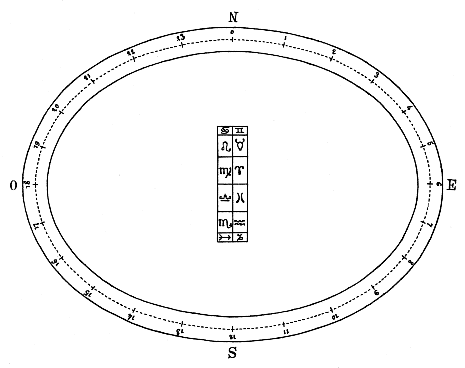
You see the unusual hour scale. The date line is divided into the zodiacal months and provided with the corresponding signs, some of which may be recognized even now. By the way: O(uest) = west.
In conclusion, this is a very special dial, with its historical-astronomical hour scale. It could celebrate its centennial in 2002. The miserable state warrants no celebration, however. Indirectly I have brought this to the attention of the Observatory, suggesting a restoration at the occasion of the anniversary. Unfortunately, the Observatory has different priorities right now, I was told. Also in this respect it is an forgotten dial!
Location: 47.2° N, 6.0° E
Design: L.-J. Gruey
Inauguration: 1902

The friendly lady urged us, though, to go and see a new vertical dial that adorns the main building of the University in the downtown area. Unfortunately, we didn't get at it anymore. Fortunately, you still can enjoy it, thanks to François Blateyron's website.
I was looking forward to visit the Museum of Time, as it should also have sundial stuff. The collection was part of the Museum of Fine Arts, but it will become an independent museum and will be housed in the Granvelle Palace, which was being redone. The museum will open in the spring of 2001, according to plans.
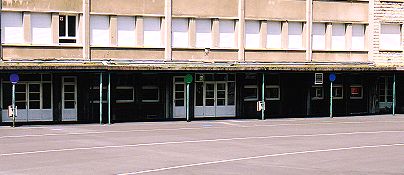
The SAF catalogue mentions an analemmatic dial in the schoolyard of the Lycée Jules Haag. It was painted there in 1983 as an educational project. The school was closed, of course (holiday season), and I wouldn't climb fences when abroad. I recognized the spot where the dial had been, though, from a picture I once saw: just in front of those middle doors.
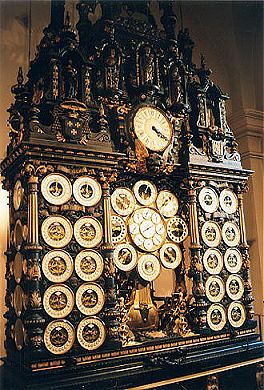 Suggestion (from the tourist guide): The Saint-John cathedral has an astronomical clock from the 19th century, which displays as many as 122 variables on 70 dials.
Websites:
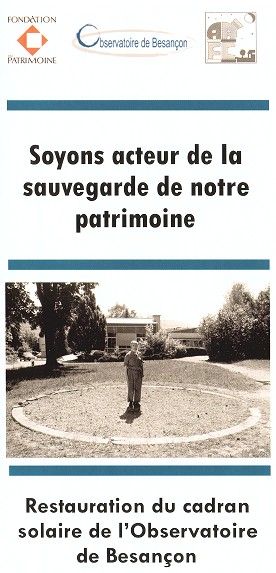 How can you contribute to the restoration?
Financial contributions for the restoration of the analemmatic sundial in Besançon can be remitted to:
The picture shows the front page of the folder that supports this campaign.